Thursday, June 19, 2014


Took a While Crocodile

Drawing a Crocodile

Prints, posters, stationery cards, and signed fine art reproductions  
are available for purchase in my Etys shop at: 
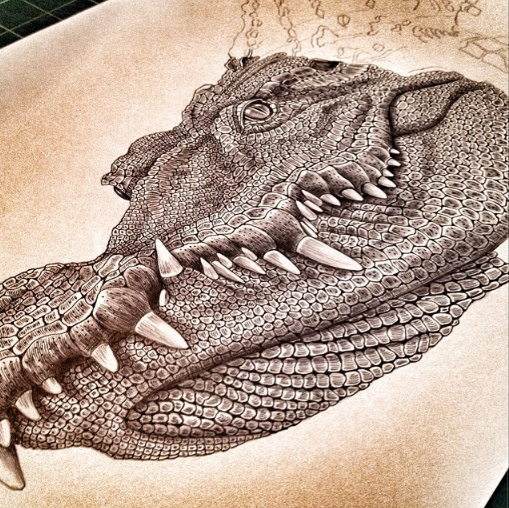
Crocodile. 11x17" Ballpoint Pen and Ink wash

Ok, I have to say, this one took longer than I expected. This Crocodile took a while! I probably put 20-25 hours of time into drawing this piece. Not that there is anything wrong with this. I love working on a single piece of art for an extended period of time. Actually, the longer the better, because I get to experience a kind of evolutionary process as the drawing progresses, and this is when I feel I get the chance to improve and learn more. Now, I don't consider myself a photo realistic artist in the least bit. I know people that can make art that you can't even tell isn't a photograph. That is a talent I just don't posses, and am not going to strive for, but what I do like is detail, and most of all I like creating patterns. Finding different patterns that somehow represent the texture and feel of the creature I am drawing, is what I love most. And repeating those patterns throughout a piece of art is where I find true happiness in making art. I never get frustrated, bored, or anxious from repetitive actions. It's more of a mediating experience that makes me very relaxed while I'm doing it. Even to the point where I can concentrate on something else, like watching TV while drawing. 


My drawing surface of choice. A self-healing cutting mat

I've tried many surfaces to draw on, from wood, to illustration board, but my preferred surface for pen work is a self-healthing cutting mat. They come in many sizes, and I find that this surface is ideal for the pressures that my pen demands. It isn't too hard or soft, but just right. This is totally a personal preference and may not work for others.

For those who might be interested, here is how I approach creating one of my drawings. Once I've come up with the animal that I'm going to draw I do quick sketches to work out the composition. After settling on the composition I do a ruff initial light sketch, in pen, on paper. I move onto what I call, "skinning the animal", by adding in the textures and patterns of the surface. This is were I get my real enjoyment. Exploring different patterns that describe the surface of the particular animal. And then I'm off to the races, at turtle speed that is, slowly constructing the animal usually from the eye out. I love starting with the eyes. One thing I will tell you about drawing with a ball point pen is that it is amazing how temperature effects the ink flow. The warmer it is, the quicker the ink comes out of the pen. When it flows fast it builds up on the pen tip and then makes blotches on the paper. So to avoid this I have a napkin in my other hand and constantly wipe the pen tip. Sometimes wiping after every 3rd or 4th line. It has become second nature to me, so it doesn't effect my drawing freedom at all, but it is something that you have to get use to. I love piecing together the patterns and working out how the scales interact with each other. Drawing one scale at a time before moving onto the next. Finally after the underlining pattern is done, I shade over the patterns to create the form, structure, and shape of the creature. Once the complete drawing is finished I do more shading to add drama. And last I black in the background with layers of india ink. ProArt is my india ink of choice since it is very opaque and covers well. If you have any other questions about my drawing techniques, please don't hesitate to write and ask me. And please forgive me for my bad grammar and misspellings. I'm NO editor, just a guy that loves to draw!

Reptiles have to be some of my favorite animals to draw. The incredible detail in their scaly skin is just cake to me! And Crocodiles are basically the coolest of the cool when it comes to reptiles. Bad to the bone!

Here are some photos taken during my drawing process
The light underlying drawing 
The detail work begins

Here you can see my drawing surface and work space


Watching TV while drawing. The World Cup!

Close up detail of the eye
The finished drawing

Prints, posters and signed fine art reproductions are available 
for purchase in my Etys shop at: 

Thursday, June 5, 2014


Bearing a White Out

Drawing a Polar Bear

Prints, posters, stationery cards, and signed fine art reproductions  
are available for purchase in my Etys shop at: 
Polar Bear. 11x17" Ballpoint Pen and Ink wash

With adult males standing 8-9 feet tall and weighting up to 1700 pounds, Polar Bears are the largest land carnivores in the world. There are an estimated 20-25,000 left in the wild, therefore classifying them as a vulnerable species.  It's scientific name "Ursus maritimus" means "maritime bear" because they spend much of their time on the Arctic sea ice in search of prey. They are incredibly adapted for the cold with thicker fur than other bears, a layer of blubber under the fur for buoyancy and insulation, and a streamlined long neck for swimming in the water and warming the air that they breath.

Attempting to draw a completely white animal with only black ink is something that's quite a challenge. And unlike most of the animals that I draw the Polar Bear doesn't have spots or patterns, but only a stark white coat of fur. Therefore it felt like almost a test of "can I do this" animal. I hope I succeeded.


Polar Bear. original photograph by AA Rosenfeld

The inspiration for this drawing came directly from an amazing photograph that AA Rosenfeld took of a Polar Bear (above). Alvin is a friend and amazing photographer. He does wildlife photography all over the world, included underwater photography, and his work is just spectacular! He graciously gave me permission to use his work as reference. You can see and purchase his amazing photographs at Images of Old Greenwich here www.imagescenter.com. Thanks again Alvin for you generosity! The one aspect I decided to change from the photo was that I wanted to make the bear appear to be looking directly back at the viewer as he walked by. So I added in the turned eye to stare the viewer down! I hope you enjoy my take on this wonderful animal.


"Finding what is hidden beneath the surface, bringing the 
unseen to light, uncovering the unknown."
 -AA Rosenfeld

Here are some photos taken during my drawing process


Prints, posters and signed fine art reproductions are available 
for purchase in my Etys shop at: 

Wednesday, May 21, 2014


A Spring Snow

Drawing a Snow Leopard

Prints, posters, stationery cards, and signed fine art reproductions  
are available for purchase in my Etys shop at: 
Snow Leopard. 11x17" Ballpoint Pen and Ink wash

The ultimate cool cat! The Snow Leopard is one of those animals that looks too beautiful to be true. Almost like an apparition, it is extremely elusive and secretive, lives in remote mountainous regions, and is incredibly well camouflaged which makes it very hard to see. Sadly it is also extremely endangered with estimates of only 4,000 to 7,000 left in the wild today. In 2008 it was placed on the Red List of threatened species. For all those reasons I just had to add this majestic cat to my list of "Big Cat" drawings. It has always been one of my favorites.


Snow Leopard. original photograph by Anthony Festa

The inspiration for this drawing came directly from an amazing photograph that Anthony Festa took of a Snow Leopard. Anthony is a friend and amazing photographer. He does landscape, nature, and wildlife photography and his work is stunning! He graciously gave me permission to use his work as reference. You can see and purchase his photos on his website at selectimagesphotographycom. Thanks again Anthony for you generosity! The only thing I decided to change from the photo was that to Snow Leopard's look appeared slightly timid to me, so I tried to achieve a more confident stare and demeanor. I hope I was successful.

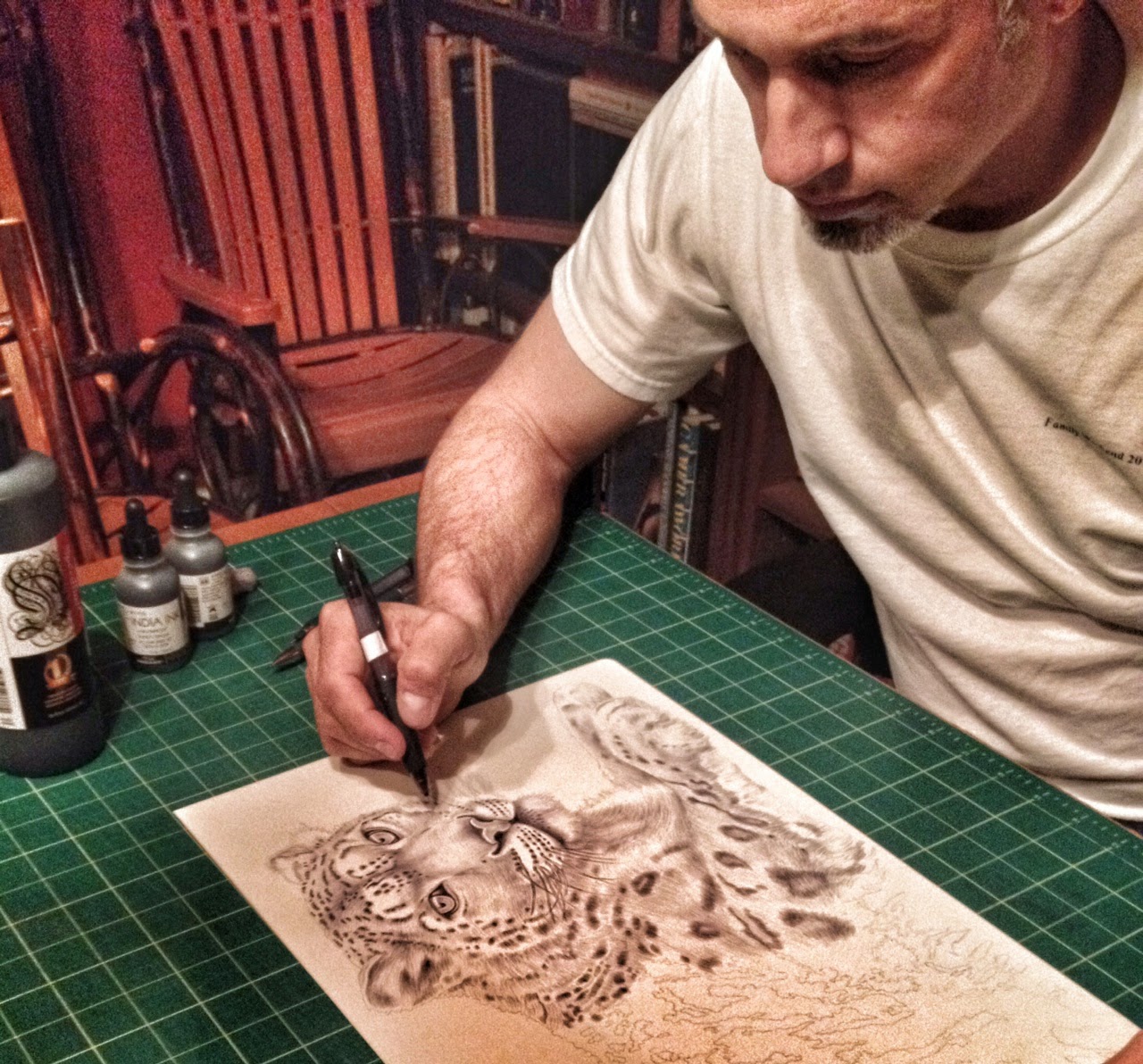
This time I took a lot more photos as I progressed through the drawing. Since people have been asking me more about my working process I thought more pictures will make it clearer. On this piece I started with a fine pencil sketch of the basic outline of the Leopard. After that the pencil is exchanged for my pen. It's all pen work from this point on. I usually always start some where on the animals face. This gives me the opportunity to breath life into the drawing, and then I slowly expand to finish the overall body. Drawing fur has always been a challenge for me. I feel I gained some knowledge this go around. I work from light to dark and begin by applying very little pressure to the pen as I let it glide across the paper. This let me draw the finest of lines. To achieve the darker areas I slowly build up those areas with layers of lines. After I have finished the inking of the animal I start brushing in the background with india ink. I love cutting out the animal. It almost feels like creating a sculpture to me. I do this with Pro Art India Ink. It's very thick and covers the papers quickly. I've noticed that different bottles have different consistencies of thickness, so I mix them to get that perfect flow. Thanks again for dropping by, and taking the time to visit my blog! It's onto the next animal for me!

Here are some photos taken during my drawing process


Prints, posters and signed fine art reproductions are available 
for purchase in my Etys shop at: 

Friday, May 9, 2014


Tapir-ing Off

Drawing a Baby Tapir

Prints, posters and signed fine art reproductions are available 
for purchase in my Etys shop at: 
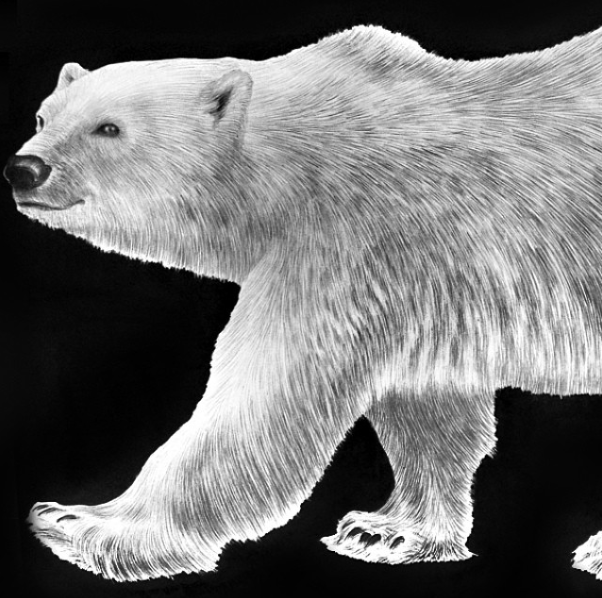
Baby Tapir. 11x17" Ballpoint Pen and Ink wash

When it comes to my list of favorite animals it starts with 1) Rhino, 2) Elephant, and 3) tapir. I love animals that look like they've lived on the planet since the dinosaurs ruled, and these three creatures definitely fit that role perfectly. The tapir showed up about 20-30 million years ago, and are actually decedents of rhinoceroses and horses. That's pretty cool fact!

Something that always struck me about the tapir is the contrasting look between an adult tapir and the infant. The infant tapir has an incredible camouflage spot pattern that is so unique and only last during infancy, while the adult has a very plain looking hide. The  detailed patterning hinds the baby from predators, and is lost as the tapir matures. Naturally I had to draw a baby. Their extremely cool looking black and white pattern on the baby tapir just screamed "draw me"!

Besides my aquatic creatures, this was one of my first full body animal drawings. I always find it challenging to draw the whole animal since so much of my art focuses in on the extreme detail of the animals features. But this time it just worked so well. I hope to do a whole series of full body animals too, so I'll consider this one the first in a series.


Today, all four species of tapir are considered to be endangered. This is mainly due to deforestation and habitat loss, and over hunting of tapirs by humans.

Here are some photos taken during my drawing process


Prints, posters and signed fine art reproductions are available 
for purchase in my Etys shop at: 

Tuesday, April 15, 2014

Lemur Lines

Drawing a Ring-tailed Lemur

Prints, posters, signed fine art reproductions, and cards are available 
for purchase in my Etys shop at: 
 www.etsy.com/shop/TimJeffsArt

Ring-tailed Lemur. 11x17" Ballpoint Pen and Ink wash

I started drawing a Ring-tailed Lemur on March 30th, without any idea that it was the first day of "Lemur Week". Lemur Week runs from March 30th to April 5th, and I found this out after one of my Facebook page followers named, Carol Smith-Nichols told me. Thanks Carol! Not only for informing me, but also following my Facebook page at facebook.com/timjeffsart. I really appreciate it. 


The drawing I did was commissioned for a large donor of Duke Universities Lemur Center, the largest sanctuary for prosimian primates in the world. You can visit their site at: lemur.duke.edu.  It's an 85-acre sanctuary for rare and endangered primates located in Durham, North Carolina. The Duke Lemur Center is the world’s largest and most diverse collection of lemurs – Earth’s most endangered group of mammals – outside of Madagascar. The Duke Lemur Center advances science, scholarship, and biological conservation through interdisciplinary research, community-based conservation and public outreach.


Lemurs are only found on the African Island of Madagascar, and there are over 100 species. The word Lemur derives from the word Lemures, which mean "ghosts or spirit" from Roman mythology. They are threatened by a host of environmental problems including deforestation, hunting, live capture of exotic pet trade and climate change. 16% of Lemurs are Critically Endangered, 23% are Endangered, 25% are listed as vulnerable  and 28% are Data Deficient.


Also, don't miss the IMAX 3D movie about Lemurs which opened on Friday April 4th. It looks amazing and is an in dept look at Lemur in the wild.! Check out the Hi-Def trailer at: islandoflemurs.imax.com

Here are some photos taken during my drawing process


Prints, posters and signed fine art reproductions are available 
for purchase in my Etys shop at: